
72 Hours, Two Flights, One Dead RIB and Absolutely No Sleep
I think I’ve forgotten what a normal sleeping schedule looks like.
It’s Sunday evening, I’m somewhere in Messina, I’ve spent the last two days chasing sailing boats around, one perfectly good plan has gone spectacularly wrong, and I have a flight back to Malta at five in the morning.
And somehow, I’m still telling myself to edit photographs.
Welcome to the Rolex Middle Sea Race.
Let’s rewind to Friday.
The skippers’ briefing. A lovely evening, everyone in good spirits, crews making their final preparations, and me doing what I do best: taking far too many photographs.
After the briefing? Edit the photos, upload everything to Dropbox, get home, pack the camera equipment, pack for Sicily, prepare everything for the start, and attempt something resembling sleep.
By the time my head hit the pillow, it was around two or three in the morning.
Naturally, my alarm was set for seven.
Four hours of sleep. Brilliant.
Saturday. Race day. Finally.
By nine in the morning, we were leaving the dock and heading out to cover the start of the 2026 Rolex Middle Sea Race.
There was just one small problem.
The wind.
Or rather, the distinct lack of it.
After all the anticipation, all the preparation, and all the excitement, the weather seemed determined to deliver possibly the least exciting start imaginable.
As a photographer, this is not ideal. You can have the most spectacular racing yachts in the world, but without wind, they’re essentially very expensive floating sculptures.
Fortunately, things got interesting.
And not necessarily for the reasons anyone expected.
During the first start, Class 6, around ten boats appeared to have completely forgotten about the first mark outside the Grand Harbour breakwater.
Some went around the correct mark. Others simply rounded the breakwater and headed off towards Sliema, apparently convinced they’d completed the necessary formalities.
Then came the realisation.
Suddenly, boats were performing U-turns all over the place, heading back upwind towards the mark they’d missed.
It was wonderful chaos. Unless, of course, you happened to be on one of those boats.
One particularly impressive example was Red Ruby, which had made it almost all the way down towards the second mark off Dragonara before turning around.
By the time she eventually rounded the correct mark, the maxis were arriving.
That’s a fairly spectacular amount of distance to sail in the wrong direction.
And yet, here’s the extraordinary bit.
As I’m writing this on Sunday evening, Red Ruby is provisionally leading her class.
Apparently, taking the scenic route isn’t necessarily a bad strategy.
Then came the big boys.
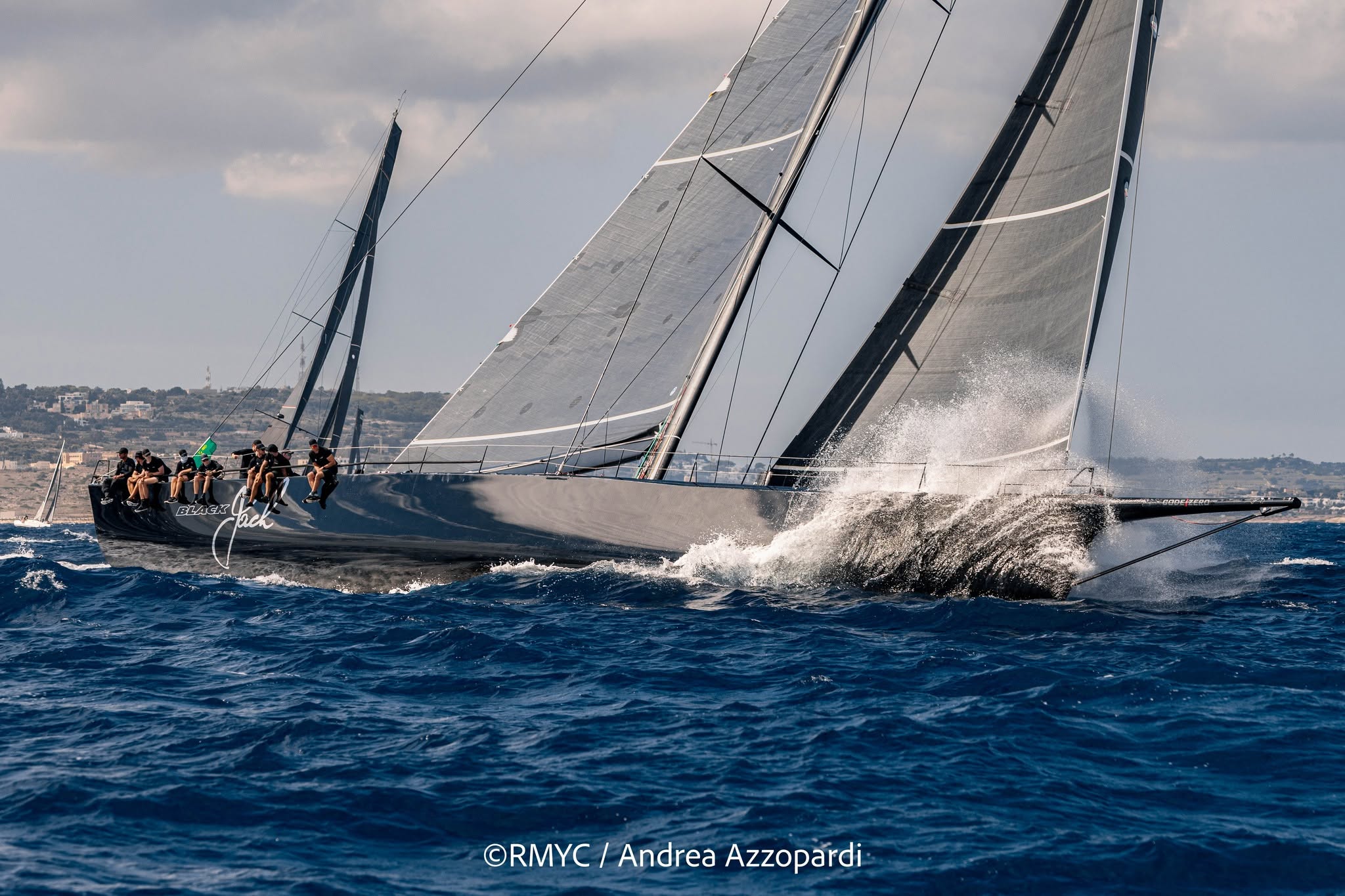
Black Jack, being Black Jack, powered out of the Grand Harbour looking like she’d quite like to get around Sicily before dinner.
Django and Balthasar followed, along with the Volvo 65s and the rest of the fleet.
We followed them down the coast, where the conditions finally started cooperating.
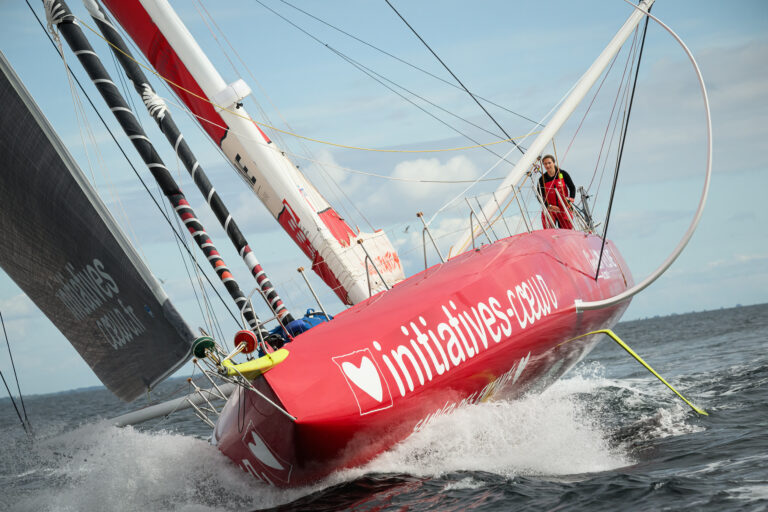
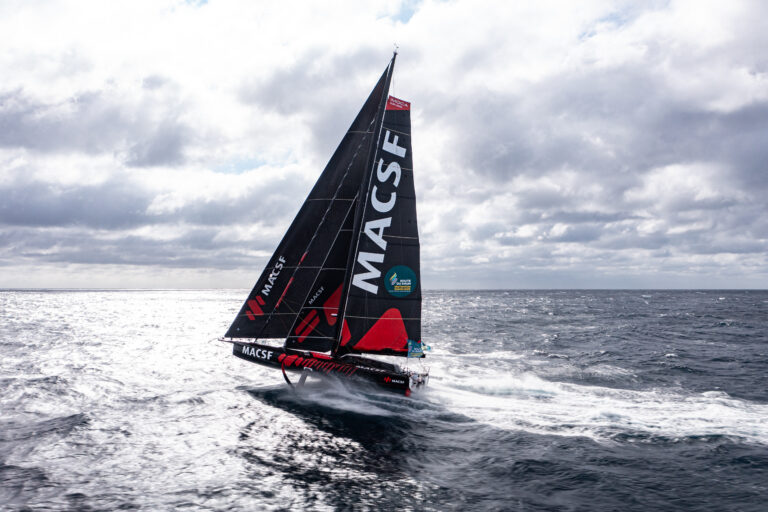
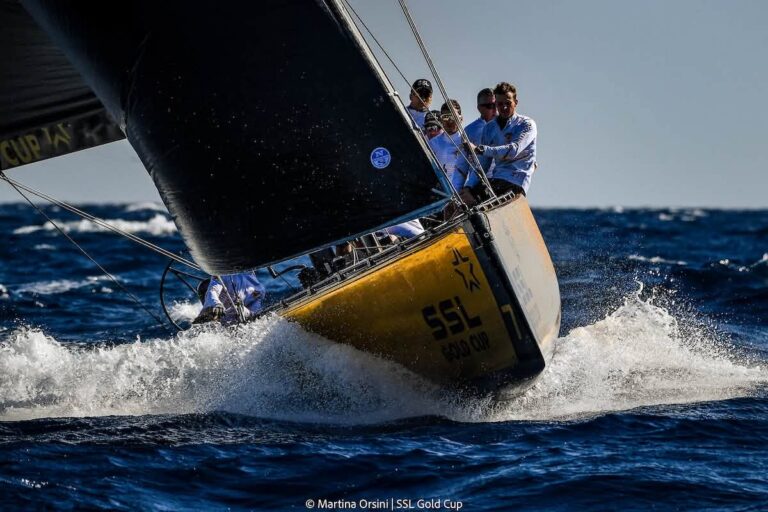
The wind picked up. The swell built. The boats began power-reaching through the waves, throwing spray off their bows, and suddenly everything I’d hoped to capture that morning was happening right in front of me.
This was more like it.
We caught up with Daguet 5, the rather gorgeous green Carkeek design I’ve previously described as the Green Lantern, and managed to get some beautiful shots of her charging through the waves.
Black Jack looked equally spectacular.
In fact, I think some of my favourite photographs from the entire start came from those few minutes offshore.
There was just one minor inconvenience.
We got a bit wet.
And when I say wet, I mean practically everyone on the RIB was wearing a substantial portion of the sea by the time we headed back.
Worth it, though.
Completely worth it.
From one RIB to an airport.
The moment we returned to the harbour, it was straight into the next adventure.
Collect the bags, collect the equipment, head to the airport, and catch a flight to Sicily.
We arrived in a fairly spectacular rush, only to discover the flight was delayed.
Of course it was.
Although, for once, a flight delay turned out to be a blessing.
I opened Lightroom and managed to churn out around thirty edited photographs from the start. The socials team got them published, and it was genuinely lovely seeing the response.
The shares, the comments, the messages, and the appreciation made the morning’s soaking feel even more worthwhile.
Eventually, we boarded, landed considerably later than planned, collected the rental car, and drove up to Messina.
We arrived at around nine that evening.
Naturally, I continued editing until one in the morning.
Because apparently, sleep is optional during the Middle Sea Race.
Sunday. Messina. The plan was simple.
We’d arranged an eight-metre RHIB with a 250-horsepower engine. My dad was going to drive, and we’d have two members of the Rolex/IMG team aboard for drone operations.
The idea was to spend the day on the water, moving around the Strait of Messina, photographing the fleet and capturing aerial footage from some rather spectacular vantage points.
We were due to leave at 6:30 in the morning.
Everything had been confirmed. Everything was apparently ready.
Except, of course, the boat.
We arrived to discover that the RHIB wouldn’t start.
Now, I’m no marine engineer, but I do believe that starting is a rather fundamental requirement of a RHIB.
The operators assured us they were preparing it.
Preparing what, exactly, remains a mystery.
Their proposed solution was to offer us another RHIB.
A tiny, roughly four-metre inflatable with a 30-horsepower engine and tubes that appeared to be losing their argument with the atmosphere.
They were actually trying to inflate them in front of us.
There were four of us, a mountain of camera equipment, drones, batteries, and the small matter of chasing offshore racing yachts through the Strait of Messina.
We politely declined.
I rather like my equipment dry and my boats capable of floating.
Plan B. Find somewhere to fly.
With the entire on-water operation effectively cancelled, we loaded everything into the car and headed towards Torre Faro.
And this is where things got rather interesting.
Pierre from IMG and I set ourselves up on the shoreline and started flying drones.
And flying.
And flying some more.
I reckon we managed easily twenty flights between the different drones throughout the day.
At one point, our biggest concern wasn’t the boats. It was batteries.
Fortunately, we found a small café on the beach and, after some fairly desperate pleading, convinced them to let us use their electricity.
This effectively became our base of operations.
Land a drone. Remove the battery. Plug it in. Insert another. Take off again.
Repeat until either the fleet has passed or the electricity supply to northeastern Sicily gives up.
It was a surprisingly effective system.
There was, however, one final complication.
Remember those weather forecasts I’d mentioned in my earlier column? The ones that never seem to agree with one another?
Well, they’d done it again.
The fastest boats, the maxis and much of the fleet we’d particularly hoped to photograph had already passed through the Strait during the night.
Fantastic.
All that planning, the flights, the accommodation, the boat booking, and the early start, only to have the weather decide that the boats should arrive several hours before we were ready for them.
Such is offshore racing.
Still, we managed to capture a considerable part of the remaining fleet, and some of the footage and photographs we got were genuinely beautiful.
It wasn’t the day we’d planned.
But it certainly wasn’t a wasted one.
And now?
Well, it’s approaching six on Sunday evening.
The last boats have passed, the sun is beginning to set, and the drones have finally been packed away.
We’re heading back to the hotel, where I suspect I’ll discover somewhere north of 100 gigabytes of photographs waiting to be sorted.
Which, of course, means another romantic evening with Lightroom.
And before anyone suggests I get some sleep, there’s one final detail.
My original flight back to Malta was booked for Monday evening at nine.
A perfectly reasonable flight. A civilised flight, even.
But with Black Jack, Django, and Balthasar potentially approaching the finish much sooner, I’ve had to book another flight.
At five in the morning.
So tonight’s programme consists of editing, possibly sleeping for an hour or two, driving approximately two hours to the airport, flying back to Malta, and hopefully being back on the water to capture the first finishers.
Simple, really.
A quick apology.
I realise the column has been a little quiet over the past couple of days.
I’d intended to write more frequently throughout the race, but between the photography, travelling, editing, and general chaos, finding the time to sit down and actually write something has proved rather difficult.
So, to the two or three people who may have been eagerly awaiting my next column, I sincerely apologise.
Hopefully there are at least four of you by now.
But this is exactly why I love this race.
There’s something rather addictive about the whole experience. The unpredictability, the long hours, the beautiful boats, the spectacular locations, and those occasional moments when everything comes together and you capture a photograph that makes the entire ordeal worthwhile.
It’s exhausting.
It’s completely ridiculous.
And I wouldn’t trade it for anything.
For now, keep an eye on the race social media pages, the Rolex Middle Sea Race coverage, and my own channels for the photographs and stories coming out of this year’s race.
I’ll hopefully be back with another column soon.
Unless I’m editing.
Or photographing a finish.
Or stuck in another airport.
Which, given how the past 72 hours have gone, is entirely possible.
Until next time.
It’s back to editing for me.