

AI Forecasting Built for Sailors
Windtrack, a Turkish app, reads five global weather models with artificial intelligence and turns them into a plain-language forecast for the exact spot a sailor cares about.
Windtrack is a new weather forecasting application developed in Turkey. Its main goal is to provide more detailed and reliable weather information, especially for sailors and yacht racing teams. One of its biggest advantages is that it focuses on the exact place a sailor cares about rather than on a large region. For each point the captain selects, the application analyses the forecast within a 20-nautical-mile radius, helping sailors understand local conditions and make better decisions at sea.
Windtrack is not just another weather forecasting application. It brings together five global weather prediction models, including ECMWF, GFS and ICON, and uses artificial intelligence to interpret them. Normally, sailors need to compare several weather models to understand which forecast is more reliable. Windtrack does this automatically. The system compares the models, measures how far they agree and evaluates the statistical differences between their predictions. It then prepares a detailed, plain-language report based on the most consistent information available. Forecasts are updated four times a day. This helps sailors save time and gives them a clearer picture of the expected weather conditions.
Another important feature of Windtrack is the way it looks at each location. For every selected point, the system does not rely on a single grid value. It samples a centre point and four surrounding points across the 20-nautical-mile radius, so that differences across the area are not missed. For sailors, this is especially important in coastal areas where mountains, valleys and islands can strongly affect wind conditions.
Windtrack also follows sudden wind shifts, gusts, rain showers and changes in precipitation, and an hourly precipitation layer shows where and when rain is expected. These differences can be extremely important, especially during yacht races, when even a small change in wind direction or speed can affect the result.
Windtrack also offers a different approach to weather monitoring during a voyage. Captains can select specific points along their planned route and enter their estimated time of arrival (ETA) for each location. The application then monitors the weather forecast for these selected points. When new forecast data becomes available, Windtrack checks whether the expected conditions have changed. If the system detects a major change in wind or weather conditions, it sends a notification to the captain. This allows sailors to review their route, reconsider their arrival times or prepare an alternative passage plan when necessary. Instead of checking weather reports manually throughout the voyage, captains receive information about important changes at the locations they have selected.
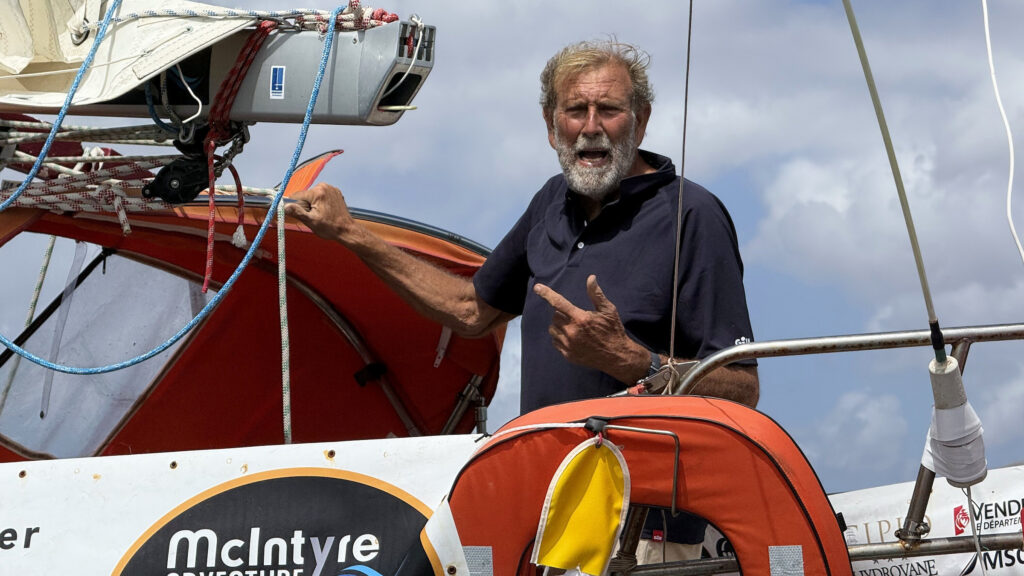
Windtrack is a Turkish technology project. However, the project is not based only on software development and meteorological data. Atilla Gökova, one of Turkey’s experienced sailing instructors and the country’s first Turkey Circumnavigation Record holder, has also contributed to the project as a maritime consultant. With more than 25 years of sailing experience, including offshore sailing, yacht racing and professional sailing instruction, Gökova has helped the development team understand the practical needs of sailors. The cooperation between the development team and an experienced sailor has helped turn Windtrack into a project designed specifically for real conditions at sea. The main idea is simple: weather information should not only be technically detailed but also useful for the person making decisions on board.
The ambitions of the Windtrack development team and Atilla Gökova go beyond weather forecasting. Their next goal is an artificial intelligence-based racing tactician. This new module, Windtrack Racer, is currently in the testing stage.
Racer’s wind forecast is not an off-the-shelf forecast bought in from outside. The team computes it on its own servers, for each race area, using internationally recognised atmospheric science methods; the details are not shared, as they are the core of the product. The computation goes down to race-area scale, to the order of hundreds of metres, and takes into account the terrain, the shape of the coastline, and air and sea surface temperatures. It is updated every day.
This makes it possible to see local effects that general weather apps, working on grids several kilometres wide, cannot: the acceleration at the mouth of a bay, the wind shadow behind a headland, local breezes driven by the temperature difference between land and sea. The forecast is continuously compared with measurement stations in the area and with other sources, so racers do not just see a forecast; they also see how far they can trust it.
On the tactical side, the racer uploads the boat’s ORC certificate, and Racer reads the boat’s performance at every wind angle and speed from it. The route is calculated not from a generic boat assumption but from that boat’s own speeds and the hour-by-hour evolution of the wind across the race area. Tack and gybe losses, laylines, mark roundings and the coastline are all taken into account. The result is the fastest route and the estimated time for that specific boat, on every leg. Several boats can be compared side by side on the same course, each with its own ORC data.
For the Windtrack team and Atilla Gökova, the long-term dream is a racing tactician that can help a sailing team win major international yacht races. Racer is still in testing, but the first steps have already been taken.
Windtrack is available on iOS and Android, and on the web. The application offers free and premium versions. The free version allows users to explore the main features of the application and follow a limited number of points. The premium version provides more detailed weather information, including the captain’s commentary, archive and forecast-versus-observation scorecard, and allows users to follow up to three points at the same time, with no limit on how many points they create over time.
This means the application is not limited to a short voyage. As the vessel moves forward, the captain can archive a point that is no longer needed and add a new one further along the route. This way, sailors can keep monitoring weather conditions throughout voyages of virtually unlimited distance. Premium users can also access detailed hourly precipitation forecasts, together with local wind and weather information.
Windtrack will continue to receive updates, including new developments related to the experimental AI racing tactician module. The application is available on the Apple App Store and Google Play.
Atilla Gökova is a maritime consultant to Windtrack.
Photo: Emre Tazegül

Leave a Reply